
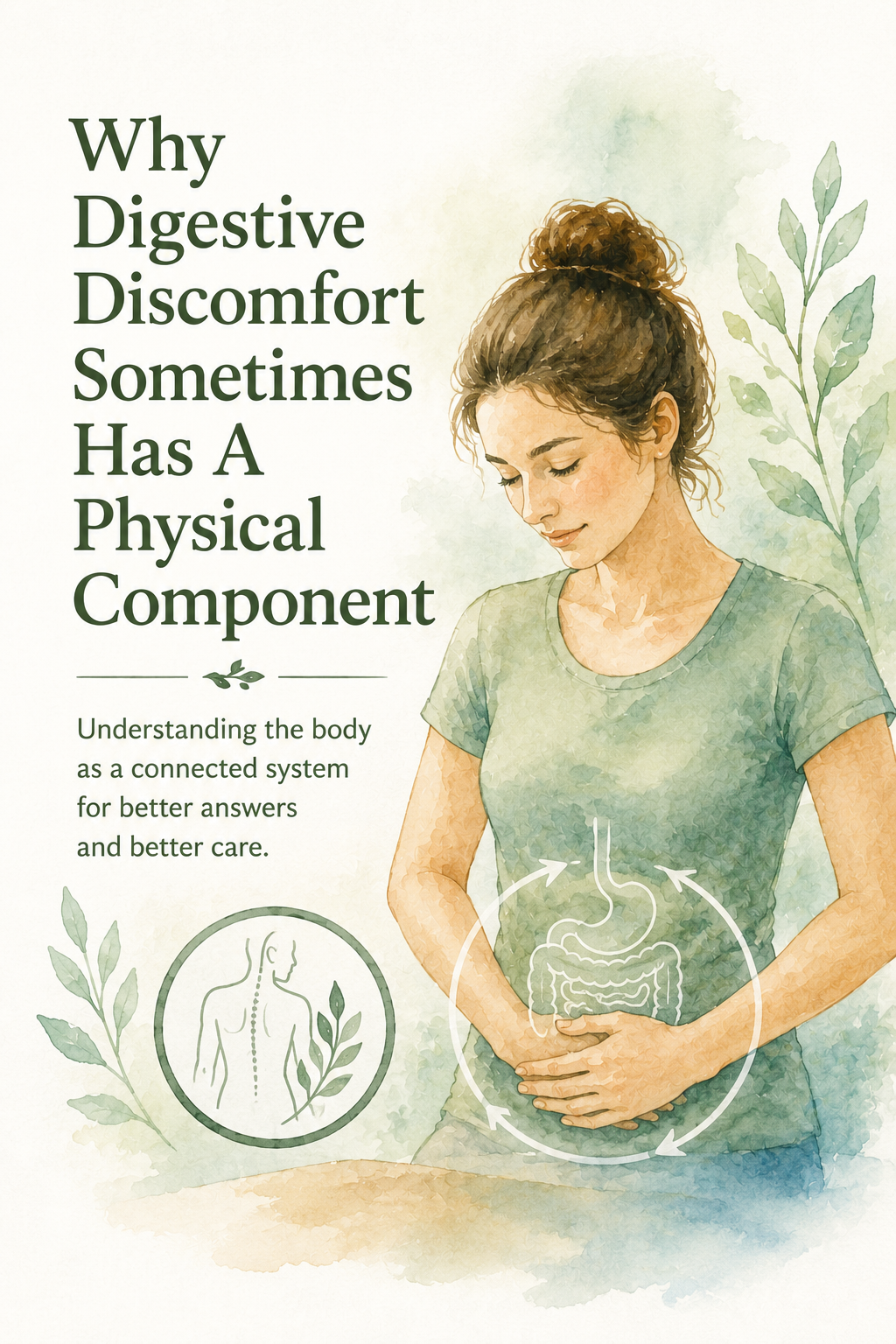
When people experience digestive discomfort, their first thoughts often turn to food.
And understandably so.
Diet can play an important role in digestive health.
However, many people are surprised to discover that digestion can also be influenced by factors such as:
- stress
- breathing patterns
- posture
- movement habits
- abdominal tension
- nervous system activity
This does not mean digestive symptoms are always caused by physical factors.
Nor does it mean manual therapy replaces appropriate medical assessment when needed.
But it does highlight an important reality:
The digestive system does not operate in isolation from the rest of the body.
The Gut And The Nervous System Are Closely Connected
Most people have experienced a “gut feeling” at some point in their lives.
Perhaps before:
- an important interview
- a public presentation
- an examination
- a stressful life event
The digestive system often responds noticeably during periods of stress.
Many people report:
- abdominal tightness
- bloating
- changes in digestion
- altered bowel habits
- a sensation of discomfort or unease
This occurs because the digestive system and nervous system communicate continuously.
When stress levels rise, the body may temporarily shift resources away from digestion and toward managing immediate demands.
While this response can be helpful in the short term, prolonged stress may influence how comfortable and efficient digestion feels.
Breathing Does More Than Bring In Oxygen
Breathing is another often-overlooked factor.
The diaphragm – the primary muscle involved in breathing – moves rhythmically with every breath.
Situated beneath the lungs and above many abdominal structures, the diaphragm creates gentle movement throughout the trunk thousands of times each day.
However, during periods of stress, many people begin relying more heavily on shallow chest breathing.
Over time, this may contribute to:
- increased tension through the chest
- reduced rib mobility
- increased abdominal tightness
- reduced movement through the diaphragm
Many people are surprised to discover how much calmer and more comfortable they feel when breathing becomes slower, deeper, and more efficient.
Posture And Prolonged Sitting
Modern life often involves long periods of sitting.
Whether working at a desk, driving, or using screens, many people spend much of the day in relatively fixed positions.
Over time, prolonged sitting may influence:
- breathing mechanics
- rib mobility
- abdominal compression
- spinal mobility
- overall movement throughout the body
This is one reason many people report feeling better after:
- walking
- gentle exercise
- stretching
- yoga
- regular movement breaks
The body is designed to move.
Movement often benefits more than just muscles and joints.
What Is Visceral Mobility?
Within osteopathy, practitioners sometimes discuss a concept known as visceral mobility.
The body’s internal organs are not rigidly fixed in place.
They move subtly with:
- breathing
- posture changes
- walking
- everyday movement
The surrounding tissues also adapt and move continuously throughout life.
Some osteopathic practitioners incorporate gentle techniques that consider these tissues alongside other aspects of mobility and function.
The aim is not to treat digestive diseases themselves, but rather to consider whether tension, movement restrictions, posture, breathing patterns, or other physical factors may be contributing to overall comfort and wellbeing.
The Body Functions As A Connected Whole
One of the central principles of osteopathy is that different systems of the body continuously influence one another.
For example:
- Stress may influence breathing.
- Breathing may affect rib mobility.
- Rib mobility may influence posture.
- Posture may affect movement.
- Movement may influence comfort and wellbeing.
The body is remarkably interconnected.
This does not mean every digestive symptom has a physical cause.
But it does remind us that there are often multiple factors contributing to how we feel.
A Whole-Body Approach To Wellbeing
At Ithaca Wellness, treatment may draw from:
- Manual Osteopathy
- Therapeutic Bodywork
- Elements of Shiatsu
- Breathing and movement awareness
Assessment often considers:
- posture
- breathing mechanics
- movement habits
- tension patterns
- stress levels
- overall function
The aim is to better understand the broader patterns that may be influencing health and wellbeing.
Looking Beyond The Symptom
One of the most useful questions we can ask is:
“What else might be contributing to how I feel?”
Sometimes the answer lies in nutrition.
Sometimes it lies in stress.
Sometimes it lies in movement, posture, breathing, or recovery.
And often, it involves a combination of factors.
The body is complex.
But it is also wonderfully interconnected.
Begin With A Consultation
If you’re interested in a whole-body approach to movement, recovery, and wellbeing, osteopathy may be worth exploring.
See what conditions Manual Osteopathy can support
MAX’S LOCATIONS FOR MANUAL OSTEOPATHY & THERAPEUTIC BODYWORK
COQUITLAM – PORT MOODY – TRI-CITIES
ITHACA WELLNESS CLINIC COQUITLAM
OR
MOBILE CONCIERGE SERVICE
OR
ONLINE VIRTUAL SESSIONS
If you have any questions about bookings or Manual Osteopathy & Therapeutic Bodywork please email Max at ithacawellnesscanada@gmail.com or call 778-929-6143
Member of British Columbia Association of Osteopathic Manual Practitioners (BCAOMP)
Fully insured
Leave a Reply