
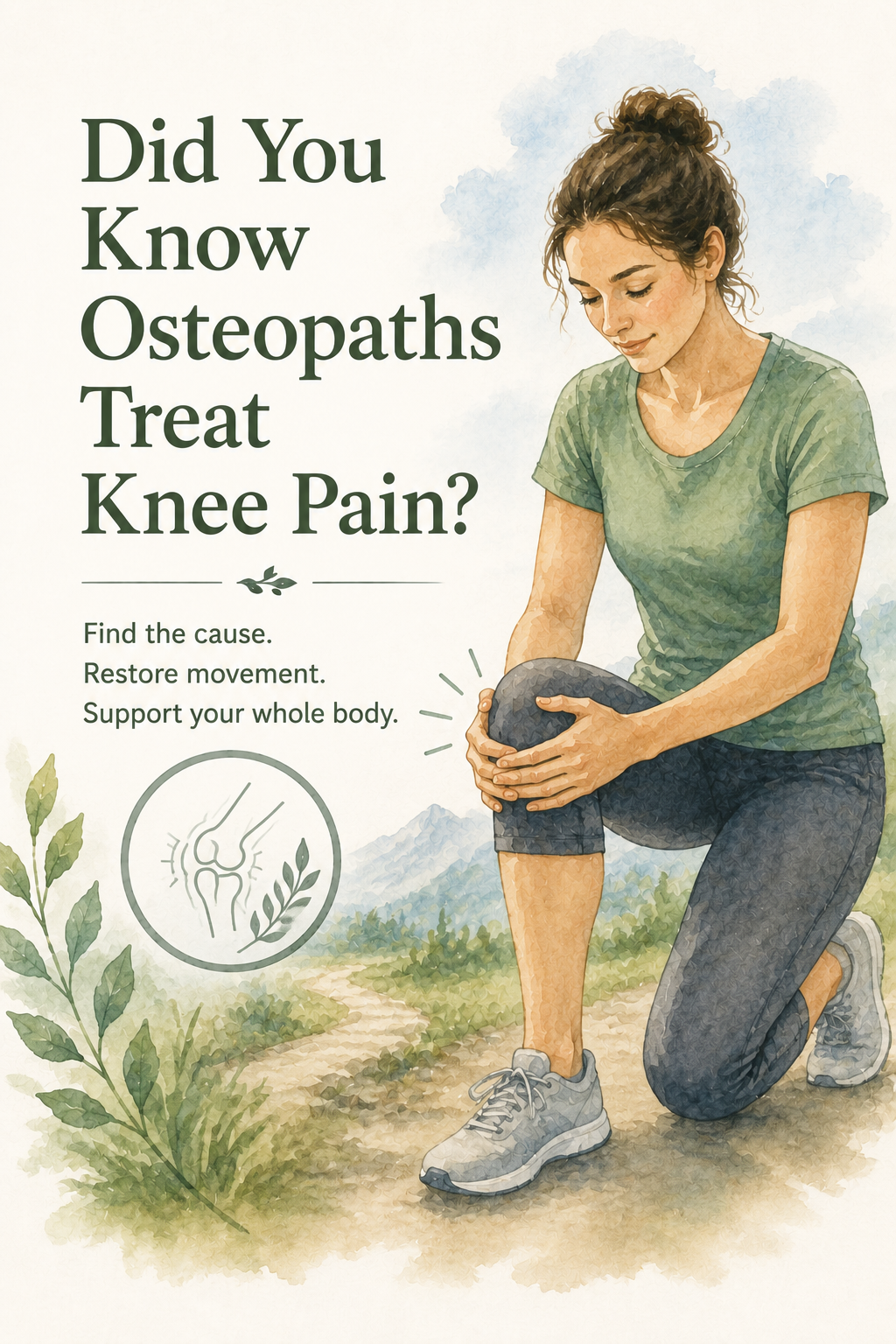
When most people think about knee pain, they immediately think of:
- physiotherapy
- sports medicine
- surgery
- injections
What many people don’t realise is that osteopaths also commonly work with knee pain and movement-related knee problems.
In fact, one of the most interesting things about osteopathy is that the knee is rarely viewed in isolation.
Instead, osteopaths often assess how the entire lower body is working together.
See what other conditions Ithaca Wellness treats using Manual Osteopathy & Therapeutic Bodywork
The Knee Doesn’t Work Alone
The knee sits between two highly influential regions:
- the hip
- the foot and ankle
Every step you take requires all three areas to work together.
If movement becomes restricted elsewhere, the knee may sometimes be asked to absorb additional stress or compensate for altered movement patterns.
This is one reason why people occasionally experience ongoing knee discomfort even when the knee itself appears relatively healthy.
Looking Beyond The Site Of Pain
One of the central principles of osteopathy is that symptoms do not always originate from the area where they are felt.
For example:
- Reduced ankle mobility may alter walking mechanics.
- Hip restrictions may change how forces travel through the leg.
- Muscle imbalances may influence knee movement.
- Previous injuries may create compensation patterns elsewhere in the body.
The painful area is not always the area creating the greatest challenge.
Sometimes it is simply the area carrying the greatest workload.
Common Contributors To Knee Discomfort
Every individual is different, but osteopathic assessment may consider factors such as:
- joint mobility
- muscle balance
- ligament function
- movement patterns
- walking mechanics
- posture
- previous injuries
- training load
This broader perspective often helps explain why some knee issues become persistent.
Understanding Compensation Patterns
Imagine driving a car with one wheel slightly out of alignment.
The vehicle may continue functioning normally for a long time.
However, additional stress may gradually be distributed elsewhere.
The body often behaves in a similar way.
When movement changes in one area, the body adapts.
Over time, these adaptations can influence:
- the knee
- the hips
- the ankles
- the lower back
This is one reason osteopaths frequently assess the entire movement chain rather than focusing solely on the knee itself.
Knee Pain Isn’t Just A Sports Problem
Many people associate knee pain with sport.
While athletes certainly experience knee issues, knee discomfort is also common among:
- office workers
- drivers
- hikers
- gardeners
- tradespeople
- active older adults
Sometimes the cause is obvious.
Sometimes it develops gradually through years of accumulated movement habits and compensation patterns.
How Osteopaths May Approach Knee Pain
Osteopathic treatment often aims to support the body’s ability to move and function more comfortably.
Depending on the individual, treatment may involve considering:
- joint mobility
- soft tissue tension
- movement patterns
- muscle energy techniques
- gentle balancing techniques
- ligament and joint mechanics
- whole-body movement relationships
The goal is not simply to focus on the knee.
The goal is to understand why the knee may be under strain in the first place.
The Importance Of Movement Quality
Many people focus on movement quantity:
How much they walk.
How much they exercise.
How many kilometres they run.
These are all important.
But movement quality matters too.
How efficiently the body moves often influences how comfortably it moves.
Sometimes small improvements in mobility, balance, coordination, and movement patterns can make a significant difference over time.
A Whole-Body Perspective
At Ithaca Wellness, treatment often draws from:
- Manual Osteopathy
- Therapeutic Bodywork
- Elements of Shiatsu
- Movement and mobility assessment
Assessment may consider:
- the knee itself
- hip mechanics
- ankle mobility
- gait patterns
- posture
- compensation patterns
- recovery capacity
The aim is to better understand the broader factors influencing comfort and movement.
The Knee May Be Telling A Bigger Story
When people experience knee pain, it is natural to focus on the knee.
Sometimes that is exactly where the problem lies.
But sometimes the knee is responding to influences elsewhere in the body.
This is one of the reasons osteopathy takes a whole-body approach.
Understanding the relationships between different regions often helps explain why symptoms develop—and why they sometimes persist.
Begin With A Consultation
If knee pain, stiffness, or reduced mobility is affecting your daily life, it may be worth exploring the broader movement patterns involved.
Sometimes understanding the whole picture provides valuable insight into the problem.
If you are having a “Wait… osteopaths treat THAT too?” moment and want to learn more about other conditions we can help with visit the many many articles in our Blog (LINK) or contact us below for a free consultation.
MAX’S LOCATIONS FOR MANUAL OSTEOPATHY & THERAPEUTIC BODYWORK
COQUITLAM – PORT MOODY – TRI-CITIES
ITHACA WELLNESS CLINIC COQUITLAM
OR
MOBILE CONCIERGE SERVICE
OR
ONLINE VIRTUAL SESSIONS
If you have any questions about bookings or Manual Osteopathy & Therapeutic Bodywork please email Max at ithacawellnesscanada@gmail.com or call 778-929-6143
Member of British Columbia Association of Osteopathic Manual Practitioners (BCAOMP)
Fully insured
Leave a Reply