
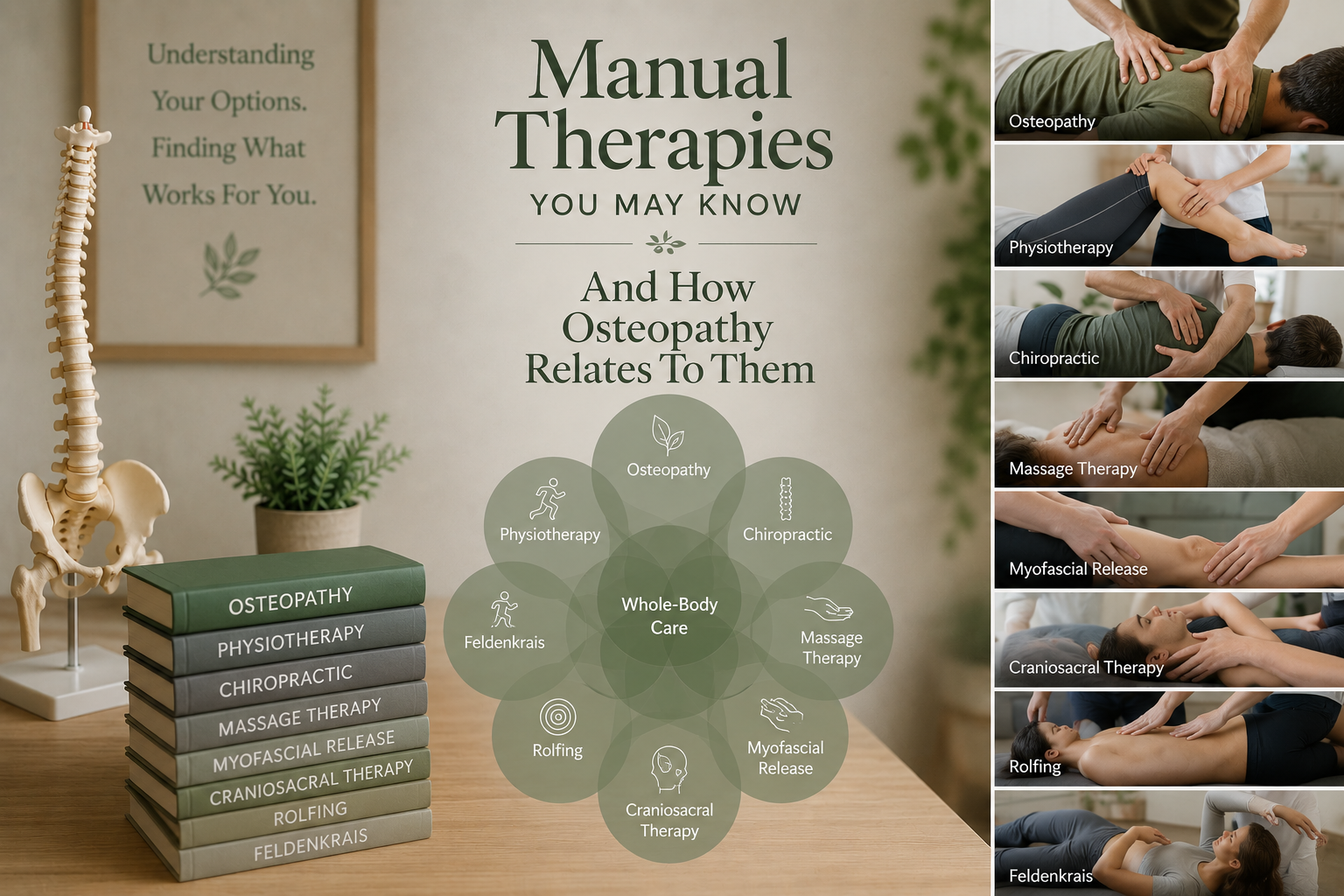
Many people have heard of therapies such as:
- Myofascial Release
- Craniosacral Therapy
- Rolfing
- Feldenkrais
Yet comparatively few people are familiar with osteopathy.
Interestingly, these approaches often share several common ideas.
While each therapy has its own philosophy, history, and techniques, many focus on themes such as:
- movement
- body awareness
- mobility
- posture
- tension patterns
- whole-body function
Understanding these similarities can help people appreciate why osteopathy is increasingly being explored as part of a broader approach to health and wellbeing.
A Shared Interest In How The Body Functions
One thing many manual and movement-based therapies have in common is the recognition that the body functions as an interconnected system.
Rather than viewing symptoms in isolation, these approaches often explore how different parts of the body influence one another.
Questions such as:
- How do you move?
- Where do you hold tension?
- How has your body adapted over time?
- Are certain areas compensating for others?
are common across many of these disciplines.
This perspective aligns closely with one of the central principles of osteopathy: the body functions best when its systems can move, adapt, and work together efficiently.
Myofascial Release
Myofascial Release focuses on the connective tissues that surround and support muscles throughout the body.
These tissues, often referred to as fascia, form a continuous network that helps transmit force, support movement, and contribute to overall body mechanics.
People interested in Myofascial Release are often exploring:
- persistent tension
- mobility restrictions
- movement limitations
- fascial tightness
Osteopathic practitioners frequently assess and work with fascial restrictions as part of a broader whole-body evaluation.
Rather than viewing fascia as separate from the rest of the body, osteopathy often considers how fascial tension may interact with joints, muscles, posture, breathing, and movement patterns.
Craniosacral Therapy
Craniosacral Therapy is often associated with gentle hands-on techniques and a focus on subtle movement throughout the body.
People who seek Craniosacral Therapy are frequently interested in:
- relaxation
- stress reduction
- body awareness
- gentle treatment approaches
Many osteopathic practitioners also incorporate gentle techniques into treatment when appropriate.
Cranial Osteopathy….
One of the strengths of osteopathy is its flexibility. Depending on the individual, treatment may range from very gentle approaches to more direct manual techniques.
The goal remains the same: to support comfort, movement, and overall function.
Rolfing
Rolfing is perhaps best known for its focus on posture, movement patterns, and the body’s relationship to gravity.
Many people explore Rolfing because they are interested in:
- posture
- alignment
- movement efficiency
- long-standing tension patterns
Osteopathy shares a similar interest in how the body adapts over time.
Rather than focusing solely on individual muscles or joints, osteopathic assessment often considers how different regions of the body influence one another and contribute to overall movement patterns.
Feldenkrais
Feldenkrais takes a somewhat different approach, placing significant emphasis on movement education and body awareness.
Rather than focusing exclusively on hands-on treatment, it encourages people to explore how they move and how greater awareness may influence comfort and efficiency.
This concept of body awareness is highly relevant to osteopathy.
Many people are surprised to discover that developing awareness of:
- posture
- breathing
- movement habits
- tension patterns
can play an important role in long-term wellbeing.
Sometimes meaningful change begins simply by recognising patterns that have previously gone unnoticed.
Why Body Awareness Matters
One of the most valuable concepts shared across many movement and manual therapies is body awareness.
Modern life often encourages us to ignore signals from the body until symptoms become difficult to overlook.
We may not notice:
- jaw clenching
- shallow breathing
- elevated shoulders
- prolonged sitting
- accumulated stress
until discomfort appears.
Developing greater awareness of these patterns can help people better understand how their body responds to everyday demands.
In many cases, awareness becomes the first step toward meaningful change.
What Makes Osteopathy Unique?
Although osteopathy shares similarities with many other therapies, it has its own distinct identity.
Osteopathic assessment often considers:
- joints
- muscles
- fascia
- movement patterns
- breathing mechanics
- posture
- compensation patterns
- recovery and lifestyle factors
The aim is not simply to focus on a single tissue or body part but to better understand how the entire system is functioning.
This whole-body perspective is one reason many people find osteopathy to be a valuable complement to other approaches they may already use.
A Growing Interest In Whole-Body Care
As understanding of movement, pain science, recovery, and body awareness continues to evolve, many people are becoming increasingly interested in healthcare approaches that recognise the interconnected nature of the body.
Whether someone is exploring Myofascial Release, Craniosacral Therapy, Rolfing, Feldenkrais, osteopathy, or another form of care entirely, the common goal is often the same:
To move more comfortably.
To function more efficiently.
And to better understand the body as a whole.
Begin With A Consultation
If you’re interested in a whole-body approach to movement, recovery, and wellbeing, osteopathy may be worth exploring.
MAX’S LOCATIONS FOR MANUAL OSTEOPATHY & THERAPEUTIC BODYWORK
COQUITLAM – PORT MOODY – TRI-CITIES
ITHACA WELLNESS CLINIC COQUITLAM
OR
MOBILE CONCIERGE SERVICE
OR
ONLINE VIRTUAL SESSIONS
If you have any questions about bookings or Manual Osteopathy & Therapeutic Bodywork please email Max at ithacawellnesscanada@gmail.com or call 778-929-6143
Member of British Columbia Association of Osteopathic Manual Practitioners (BCAOMP)
Fully insured
Leave a Reply