
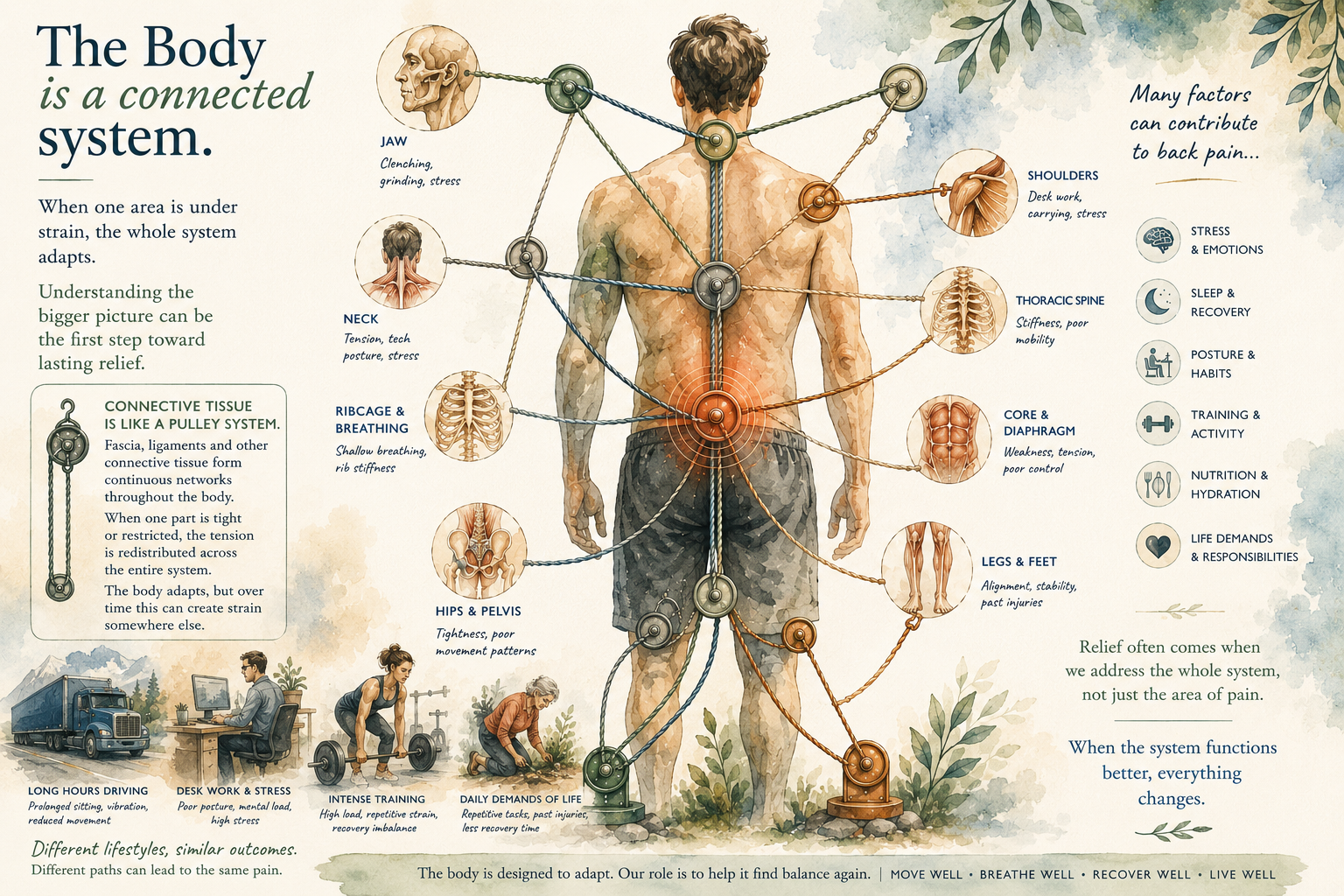
Back pain is one of the most common reasons people seek treatment. I would say nearly 80% of my clients come to me with some kind of back pain and if I include the whole spine with the neck vertebra then that percentage could easily rise to 90%.
Yet many people are surprised to discover that the factors contributing to their pain are often far more complex than they initially realise. Complex yet solvable.
Some people stretch every day.
Some exercise regularly.
Some have already tried multiple treatments.
Yet the pain continues to return.
So what makes the difference for those who finally begin to improve?
Often, it starts by looking beyond the painful area itself.
Back pain is not always just a back problem
When pain has been present for weeks, months, or even years, the body has often developed broader patterns of compensation.
These can involve:
- movement habits
- stress levels
- breathing patterns
- sleep quality
- recovery capacity
- work demands
- previous injuries
The painful area may simply be the place where the body is struggling to cope with accumulated load.
One of the most important questions in osteopathy is not:
“Where does it hurt?”
but rather:
“Why is this area carrying so much strain?”
Different people, different patterns
One of the fascinating things about chronic back pain is that two people with very similar symptoms can arrive there through completely different pathways.
Let’s take a look at some different examples.
The long-distance driver
Many professional drivers spend hours sitting in a relatively fixed position.
Over time this may contribute to:
- reduced movement variability
- hip stiffness
- spinal compression
- reduced circulation
- accumulated tension through the lower back
One common pattern we often see is that the back is not necessarily weak.
It is simply being asked to tolerate the same position for prolonged periods without sufficient opportunity to recover.
As movement, mobility, and recovery strategies improve, many drivers notice significant changes in comfort levels.
The gym enthusiast
Interestingly, some of the strongest people can experience persistent back pain.
Many active individuals are highly disciplined with exercise but may overlook:
- recovery
- breathing patterns
- nervous system load
- movement variability
Sometimes the issue is not a lack of strength.
Sometimes it is an inability to fully recover from the demands being placed on the body.
A common observation is that pain often decreases when training, recovery, mobility, and overall stress levels become better balanced.
The chronically stressed professional
Not all back pain begins with lifting something heavy.
For some people, stress appears to be a major contributor.
Long periods of pressure, responsibility, and mental load often coincide with:
- increased muscle tension
- reduced recovery
- poorer sleep
- heightened pain sensitivity
One pattern frequently observed in practice is that as stress levels rise, physical tension often rises alongside it.
The body and mind are rarely operating separately.
To learn more about tension and stress patterns read our piece on Why Some Tension Patterns Don’t Resolve (Even With Treatment)
The person who has “tried everything”
Many people arrive feeling frustrated.
They have:
- stretched
- rested
- exercised
- purchased ergonomic equipment
- watched countless videos
Yet the symptoms continue.
Often these individuals benefit from stepping back and looking at the bigger picture.
What is happening throughout the entire system?
How is recovery?
How is sleep?
How is breathing?
How much stress is the body carrying?
Sometimes meaningful progress begins when we stop chasing symptoms and start understanding patterns.
And for those of you who have tried many things to get rid of headaches but with no avail, read our article here to find out how osteopathy can help Why Headaches Keep Returning (Even When You’re Doing Everything Right)
The hidden role of compensation patterns
One concept that often helps explain persistent back pain is something known as a compensation pattern.
The body is remarkably adaptable.
When one area becomes stiff, weak, irritated, restricted, or overloaded, the body will often find another way to accomplish the same movement.
In the short term, this can be very helpful.
In the long term, however, these compensations can sometimes create additional strain elsewhere.
One way to think about this is like a system of interconnected pulleys.
If one pulley becomes tight or restricted, the tension is redistributed throughout the entire system.
The body functions in a similar way.
Muscles, joints, fascia, ligaments, nerves, circulation, breathing mechanics, and movement patterns all interact continuously.
For example:
- A stiff hip may increase demands on the lower back.
- Reduced rib mobility may alter breathing mechanics and increase tension through the neck and shoulders.
- An old ankle injury may subtly change the way forces travel through the knees, pelvis, and spine.
- Ongoing stress may increase muscle guarding throughout multiple regions of the body.
Over time, these adaptations can become so familiar that people no longer notice them.
The body simply learns to operate around the restriction.
One of the reasons a whole-body approach can be valuable is that it looks beyond the area where symptoms appear.
The painful area is not always the area creating the greatest challenge.
Sometimes it is the part of the system working hardest to compensate.
When movement, breathing, mobility, and overall balance begin improving throughout the system, people often discover that longstanding tension patterns start making much more sense.
The goal is not to find a single cause for every symptom.
The goal is to better understand how the body has adapted—and whether those adaptations are still serving us well.
Why stress and recovery matter more than many people realise
Research increasingly highlights the importance of recovery in overall wellbeing.
The body is remarkably adaptable.
But adaptation requires periods of rest, recovery, and regulation.
When stress remains elevated for prolonged periods, people may notice:
- increased tension
- greater sensitivity to discomfort
- slower recovery
- persistent fatigue
This does not mean the pain is “all in the head.”
Quite the opposite.
It reflects the reality that the nervous system influences how the body experiences and responds to strain.
Why a whole-body approach often helps
At Ithaca Wellness, treatment often involves looking beyond the area of pain itself.
This may include considering:
- spinal mobility
- hip and pelvic mechanics
- breathing patterns
- movement habits
- stress levels
- recovery capacity
- nervous system regulation
Treatment may draw from:
- manual osteopathy
- therapeutic bodywork
- elements of shiatsu
- movement and breathing awareness
The goal is not simply to reduce symptoms temporarily.
The goal is to better understand the broader factors that may be contributing to them.
A common thread among people who improve
Over the years, one of the most consistent observations in practice has been this:
People often begin improving when they stop searching for a single cause and start addressing the broader pattern.
They begin moving differently.
Recovering better.
Breathing more freely.
Managing stress more effectively.
Understanding their body more deeply.
The result is often not just less pain.
It is greater resilience, comfort, and confidence in everyday life.
Begin with a consultation
If your back pain keeps returning despite doing many of the “right” things, it may be worth exploring the broader pattern involved.
Max Edwards
Osteopathic Manual Practitioner & Bodywork Specialist
Owner
Ithaca Wellness
– Pain Relief – Stress Reduction – Wellness –
M: 778-929-6143
E: ithacawellnesscanada@gmail.com
To book appointments use the booking links below:
For appointments @ Ithaca Wellness Clinic Coquitlam & Mobile & Online follow the link https://ithaca.noterro.com
Follow us @ Facebook & Instagram & Threads
Write us a Google Review and get $10 OFF your next treatment!
Providing manual osteopathy and therapeutic bodywork to the communities of Coquitlam, Port Moody and Tri-Cities
Professional osteopathic care – in-clinic and home visits
Member of British Columbia Association of Osteopathic Manual Practitioners (BCAOMP) – Fully insured and licensed.
Leave a Reply