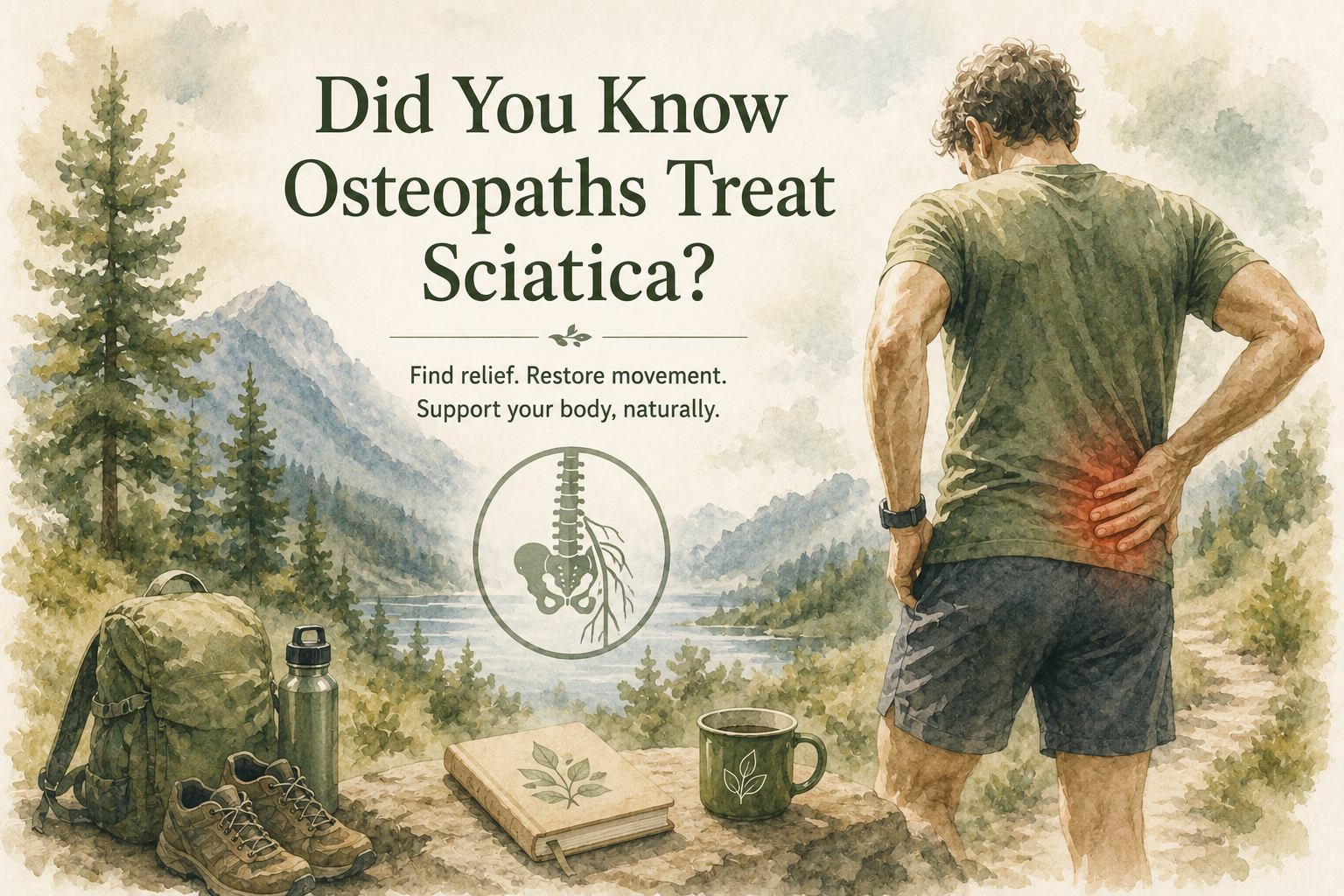
When people hear the word sciatica, they often think of:
- lower back pain
- pain shooting down the leg
- trapped nerves
- slipped discs
Many also assume that treatment options are limited to physiotherapy, chiropractic care, injections, or surgery.
What many people don’t realise is that osteopaths also commonly assess and work with people experiencing sciatica and sciatic-like symptoms.
What Is Sciatica?
Sciatica is not actually a diagnosis itself.
Rather, it is a term commonly used to describe symptoms involving irritation or sensitivity of the sciatic nerve.
People often describe:
- pain travelling down the leg
- tingling
- numbness
- burning sensations
- weakness
- discomfort in the buttock, thigh, calf, or foot
The experience can vary significantly from person to person.
Some people have mild symptoms.
Others find it has a major impact on their daily life.
The Sciatic Nerve Is The Largest Nerve In The Body
The sciatic nerve travels from the lower back through the pelvis and buttock before continuing down the leg.
Because of this long pathway, symptoms may sometimes be influenced by structures in several different regions of the body.
This is one reason osteopaths often take a broader view when assessing sciatic symptoms.
The Source Is Not Always The Same
Many people assume all sciatica originates from the lower back.
Sometimes this is true.
However, symptoms can involve a variety of contributing factors.
Depending on the individual, assessment may consider:
- lumbar spine mobility
- pelvic mechanics
- hip movement
- muscle tension
- posture
- walking patterns
- previous injuries
- recovery and lifestyle factors
The body is complex, and similar symptoms can sometimes arise from different underlying patterns.
Looking Beyond The Pain
One of the central principles of osteopathy is that symptoms do not always tell the whole story.
For example:
- A restricted hip may alter movement patterns.
- Pelvic imbalances may influence load distribution.
- Muscle tension around the pelvis and buttock may affect comfort.
- Previous injuries may contribute to compensation patterns elsewhere in the body.
This does not mean these factors are always the cause.
But it does explain why osteopaths often assess more than just the painful area itself.
Not Every Case Of “Sciatica” Is The Same
One of the reasons sciatic symptoms can be confusing is that different structures may sometimes create similar sensations.
For example, people experiencing:
- buttock pain
- leg pain
- tingling
- nerve-like symptoms
often assume they have sciatica.
Sometimes they do.
However, symptoms can occasionally involve factors such as:
- muscle tension around the hip and pelvis
- piriformis-related irritation
- movement restrictions
- compensation patterns
- sensitivity within surrounding tissues
This is one reason assessment is so important.
The symptoms may feel similar, but the factors contributing to them can vary considerably from one person to another.
Rather than focusing solely on the label, osteopathic assessment often aims to better understand the broader pattern influencing the symptoms.
Understanding Piriformis And The Hip
One structure that often receives attention in discussions about sciatic symptoms is the piriformis muscle.
Located deep within the buttock, the piriformis helps control hip movement and stability.
Because the sciatic nerve travels through the same region, tension or irritation around these tissues may sometimes contribute to symptoms that resemble sciatica, including:
- buttock discomfort
- pain down the leg
- tingling
- nerve-like sensations
This does not mean the piriformis is always responsible.
Rather, it highlights the importance of considering the hip, pelvis, and surrounding tissues alongside the lower back when assessing sciatic symptoms.
Compensation Patterns Matter
The body is remarkably adaptable.
When one area becomes restricted or uncomfortable, other areas often compensate.
Over time this may influence:
- the lower back
- the pelvis
- the hips
- walking mechanics
- muscle activity
Sometimes the body adapts so effectively that the original source of strain becomes difficult to identify without a broader assessment.
This is one reason osteopaths frequently look at how the entire system is functioning.
How Osteopaths May Approach Sciatica
Osteopathic treatment often aims to support comfortable movement and whole-body function.
Depending on the individual, treatment may involve considering:
- spinal mobility
- pelvic mechanics
- hip movement
- muscle energy techniques
- soft tissue tension
- balancing techniques
- movement patterns
- recovery and lifestyle factors
The goal is not simply to focus on the site of symptoms.
The goal is to better understand the broader factors that may be contributing to discomfort.
A Whole-Body Perspective
At Ithaca Wellness, treatment often draws from:
- Manual Osteopathy
- Therapeutic Bodywork
- Elements of Shiatsu
- Movement and mobility assessment
Assessment may consider:
- lumbar spine mobility
- pelvic alignment
- hip mechanics
- walking patterns
- muscle balance
- compensation patterns
- recovery capacity
This whole-body perspective often helps explain why symptoms may persist and what factors may be worth addressing.
Sometimes The Leg Is Telling A Bigger Story
Many people understandably focus on where they feel symptoms.
In the case of sciatica, that is often the leg.
But the structures influencing those symptoms may involve the lower back, pelvis, hips, muscles, movement patterns, and the body’s broader adaptation strategies.
This is why osteopathy looks beyond the symptom itself and explores how the entire system is functioning.
Begin With A Consultation
If sciatica, leg pain, tingling, or nerve-related discomfort is affecting your quality of life, it may be worth exploring the broader movement patterns involved.
Sometimes understanding the bigger picture provides valuable insight into persistent symptoms. The same symptom can have different causes.
MAX’S LOCATIONS FOR MANUAL OSTEOPATHY & THERAPEUTIC BODYWORK
COQUITLAM – PORT MOODY – TRI-CITIES
ITHACA WELLNESS CLINIC COQUITLAM
OR
MOBILE CONCIERGE SERVICE
OR
ONLINE VIRTUAL SESSIONS
If you have any questions about bookings or Manual Osteopathy & Therapeutic Bodywork please email Max at ithacawellnesscanada@gmail.com or call 778-929-6143
Member of British Columbia Association of Osteopathic Manual Practitioners (BCAOMP)
Fully insured