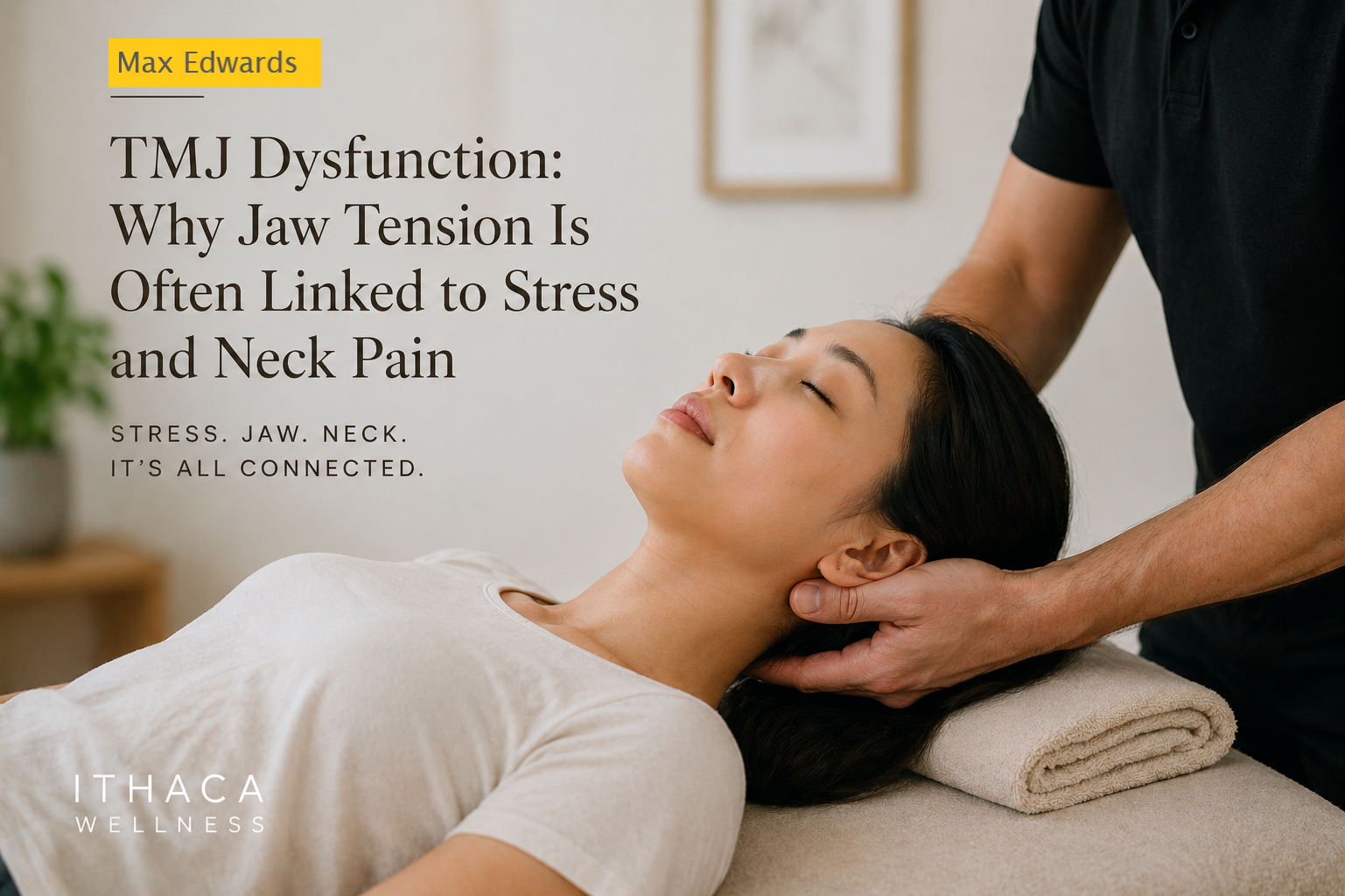
TMJ Dysfunction: Why Jaw Tension Is Often Linked to Stress and Neck Pain
If you’re experiencing tightness, clicking, or discomfort in the jaw, it’s natural to focus on the joint itself.
But in many cases, the jaw is responding to a wider pattern and rarely exists in isolation – particularly involving the neck and the nervous system.
This is why TMJ symptoms are often persistent, and why they can fluctuate depending on stress, workload, or posture.
The connection between the jaw and the neck
The jaw and neck are closely linked – both structurally and functionally.
Muscles that control jaw movement also interact with those of the neck and upper spine.
Because of this, tension in one area can influence the other.
Common patterns include:
- Neck stiffness alongside jaw tightness
- Pain that radiates into the temples or behind the eyes
- Increased symptoms after long periods of desk work
In many cases, the jaw is not the starting point – but part of a broader system under strain.
The role of stress and the nervous system
Stress doesn’t just affect how we feel – it changes how the body behaves.
Under ongoing stress or cognitive load, the nervous system can shift into a more heightened state.
This often leads to:
- Increased background muscle tension
- Jaw clenching or grinding (often subconscious)
- Reduced ability for muscles to fully relax
Over time, this creates a pattern where the jaw remains slightly “held,” even at rest.
Why TMJ symptoms tend to fluctuate
One of the most common features of TMJ dysfunction is inconsistency.
Symptoms may:
- Feel worse during busy or stressful periods
- Ease when you’re more relaxed or away from work
- Change location or intensity over time
This variability is a strong indicator that the issue is not purely mechanical – but influenced by how the body is regulating overall tension.
Why treating the jaw alone often isn’t enough
Local treatment of the jaw can be helpful.
It may:
- Improve movement
- Reduce pain
- Provide short-term relief
But if contributing factors such as neck tension or nervous system load are not addressed, symptoms often return.
This is why TMJ issues can feel cyclical.
Read our other article on TMJ Dysfunction here
A more integrated way to approach TMJ dysfunction
A more complete approach considers how the jaw, neck, and nervous system interact.
At Ithaca Wellness, treatment draws from:
- Manual osteopathy
- Therapeutic bodywork
- Elements of shiatsu
This allows care to be adapted to the individual, rather than focusing on a single area.
Treatment may include:
- Addressing tension through the neck and upper body
- Improving movement and load distribution
- Working with breathing patterns
- Supporting the nervous system in reducing overall tone
- Gentle, specific work around the jaw where appropriate
The aim is to shift the broader pattern – not just manage symptoms.
When to take a more individual approach
You may benefit from a more detailed assessment if:
- Your jaw symptoms keep returning
- You notice a link between stress and tension
- You also experience neck pain or headaches
- Treatment has helped, but not fully resolved the issue
A more personalised way to work
For more persistent or complex patterns, a more individual approach is often required.
This allows for:
- A deeper understanding of contributing factors
- Greater continuity between sessions
- More precise, tailored treatment
Private osteopathy sessions are available for those seeking a more unhurried, one-to-one experience.
This can also include mobile or in-home treatments, offering a more convenient and discreet option.
👉 Learn more here:
Private Mobile Concierge Osteopathy & Personalised Care
Begin with a consultation
If your jaw tension isn’t resolving – or seems linked to stress or neck discomfort – a structured assessment can help clarify what’s driving it.
👉 Book a consultation
👉 Or explore osteopathy in Coquitlam
Begin with a consultation
If your jaw tension isn’t improving – or keeps returning – a structured assessment can help clarify what’s driving it.
👉 Book a consultation
👉 Or explore osteopathy in Coquitlam
Appointments are limited each week to ensure quality care.
FAQ
Do you offer osteopathy near me in the Tri-Cities?
Yes — the clinic is conveniently located for patients in central Coquitlam which is also a short distance from Port Coquitlam and Port Moody.
We welcome patients from Coquitlam, Port Coquitlam, Port Moody, and across the lower mainland area…
Do I need a referral? → No
What should I wear? → Comfortable clothing. Jeans and skirts are not recommended.
Is it covered by insurance? → Ithaca Wellness is not an insurance-based business. However, most major extended benefits insurance companies accept claims for manual osteopathy treatments. PLEASE CHECK YOUR POLICY COVERAGE TO CONFIRM WHETHER OR NOT BCAOMP MEMBERS ARE ACCEPTED BY YOUR PROVIDER PRIOR TO BOOKING IF UNSURE.
👉 Book your osteopathy appointment in Coquitlam now
Member of British Columbia Association of Osteopathic Manual Practitioners (BCAOMP) – Fully insured and licensed.
To book appointments use the booking links below:
Mobile & Online Appointments https://ithaca.noterro.com
@ Dovira Clinic, Coquitlam https://dovira.janeapp.com/
Follow us @ Facebook & Instagram & Threads !
Write us a Google Review and get $10 OFF your next treatment!
Providing manual osteopathy and therapeutic bodywork to the communities of Coquitlam, Anmore, Belcarra, Port Moody, Burke Mountain, Westwood Plateau, Tri-Cities, and Greater Vancouver!
Professional osteopathic care – in-clinic appointments and home visits!